



-
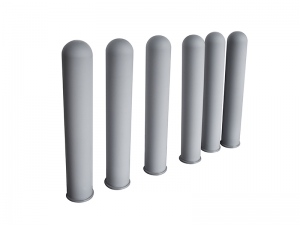
Silicon Nitride (Si₃N₄) Protection Tubes for the Molten Aluminum Industry
1. Why Protection Tube Material Matters in Molten Aluminum
In an aluminum foundry, the protection tube is the only barrier between a temperature sensor, an immersion heater, or a melt-contact component and a 660–900 °C bath of molten aluminum. It must survive direct contact with corrosive liquid metal, repeated thermal shock from raising and lowering, and the build-up of dross — while never contaminating the alloy it protects.
Traditional tubes fail these demands. Cast iron and alloy steel are attacked by the melt and leach iron into the aluminum, which destroys the ductility of the casting. Graphite oxidizes rapidly and introduces carbon contamination. Alumina offers reasonable corrosion resistance but is brittle and cracks under thermal cycling. Pure silicon nitride (Si₃N₄) solves all of these problems at once.
2. Core Advantages of Pure Silicon Nitride (Si₃N₄)
2.1 Non-Wetting to Molten Aluminum
Pure Si₃N₄ is thermodynamically stable in contact with molten aluminum and exhibits virtually zero wetting — the melt beads up and rolls off its surface instead of adhering. This eliminates dross build-up, keeps the melt free of impurities, and makes the tube essentially maintenance-free. It is a decisive advantage for high-purity structural castings where iron or carbon contamination is unacceptable, such as aluminum wheel hubs.
2.2 Exceptional Thermal Shock Resistance
Silicon nitride has one of the highest thermal shock resistance ratings among technical ceramics. A Si₃N₄ tube can be dipped directly into molten metal without preheating and withdrawn repeatedly without cracking — even across weekend shutdowns and intermittent production. This simplifies operation, removes the preheating step, and eliminates the cracking failures that plague alumina tubes.
2.3 Corrosion and Oxidation Resistance
Gas-pressure-sintered silicon nitride achieves near-zero porosity and resists chemical attack from molten aluminum and standard alloying elements such as magnesium and zinc. It is fully suitable for 5000 and 7000 series alloys without material degradation, and unlike graphite it does not oxidize in high-temperature service.
2.4 High Strength and Density
With a flexural strength of roughly 580 MPa or higher and a density of 3.1–3.3 g/cm³, silicon nitride withstands the high speeds and mechanical loads of degassing rotors and the repeated mechanical cleaning of thermocouple wells. It is denser and stronger than reaction-bonded and competitive ceramic grades.
2.5 Low Thermal Expansion and Long Service Life
A low coefficient of thermal expansion keeps dimensions stable over years of service, preserving measurement accuracy and component geometry. In real foundry service, pure Si₃N₄ protection tubes deliver 12 months to 2–3 years of continuous operation, far beyond cast iron (1–2 weeks), silicon carbide (1–3 months) or alumina.
3. Pure Si₃N₄ vs. Conventional Protection Tube Materials
Property
Cast Iron
Graphite
Alumina (Al₂O₃)
Pure Si₃N₄
Resistance to melt attack Poor
Poor (oxidizes)
Good
Excellent
Thermal shock resistance Fair
Poor
Fair
Excellent
Melt contamination Iron
Carbon
Low
None
Typical service life 1–2 weeks
Frequent replacement
3–12 months
12 months – 3 years
Maintenance Constant replacement
High
Moderate
Nearly zero
Table 1. Comparison of protection tube materials in molten aluminum service.
4. Real-World Application Cases
Case 1 — Die Casting: From Weekly Changes to Annual Reliability
A die-casting line suffering frequent cracking of its ceramic protection tubes replaced the standard (alumina) tubes with a single Si₃N₄ tube. The result: the one silicon nitride tube survived a full year of production, including numerous weekend shutdowns, eliminating thermal crack failures. The station saved the direct cost of 30+ alumina tubes and over 60 hours of maintenance labor, while consistent temperature readings improved shot consistency and reduced porosity-related scrap. (Source: SF-Foundry)
Case 2 — Molten Aluminum Casting: Scrap Rate Cut from 4% to 0.8%
A molten aluminum casting operation switched its thermocouple protection wells from cast iron to a silicon-nitride-based (Sialon) material. The high modulus of rupture withstood daily mechanical cleaning with zero breakage, and precise thermal control reduced the scrap rate from 4% to 0.8%. Although the initial unit cost was higher, eliminating weekly replacements and cutting scrap delivered a net saving of $42,000 per furnace per year. (Source: AdTech)
Case 3 — Immersion Heaters: 2–3 Years of Continuous Operation
Foundries protecting immersion heaters in in-line degassing and dosing systems (e.g., ALPUR, SNIF, Hertwich, Striko Westofen) report 2–3 years of continuous silicon nitride heater-tube service with minimal cleaning — far superior to cast iron or aluminium titanate riser tubes, which fail quickly or require frequent replacement. (Source: Sialon Ceramics)
Case 4 — Thermocouple Sheaths: 12 Months vs. Cast Iron’s 3–4 Weeks
In molten aluminum, zinc and magnesium service, a premium silicon nitride (Sialon) thermocouple sheath delivers a service life of up to 12 months. By comparison, cast iron sheaths erode in only 3–4 weeks while contaminating the melt with iron, demanding constant replacement and risking casting quality. (Source: Hongtai Heating Elements)
5. Service Life Comparison at a Glance
Material
Typical Service Life
Cast iron 1–2 weeks
Silicon carbide (SiC) 1–3 months
Alumina (Al₂O₃) 3–12 months
Pure Si₃N₄ / Sialon 12 months – 3 years
Table 2. Typical service life of protection tube materials in molten aluminum.
6. Application in the Field
Pure silicon nitride protection tubes are proven in aluminum melting, holding, degassing and die-casting around the world, as illustrated below.
-

Silicon nitride ceramics
Silicon nitride ceramics are gaining popularity due to their diverse applications and high performance properties. From energy and the environment to the automotive industry, these advanced ceramics play a vital role in enhancing performance, durability and efficiency. In this blog, we will explore the various applications of silicon nitride ceramics and delve into the unique characteristics that set them apart in the market.
One of the main applications of silicon nitride ceramics is the polysilicon reaction reduction furnace. These furnaces require insulating rings, heat shields and insulating bushings that can withstand high temperatures and provide a long service life. Silicon nitride ceramics have proven to be an excellent choice for these components due to their high temperature resistance and durability. By using silicon nitride ceramics, not only can the replacement frequency be reduced, but also cost can be saved, making it an optimal solution for energy and environment related applications.
Another area where silicon nitride ceramics shine is the aluminum foundry industry. The denseness, high temperature strength, thermal shock resistance and corrosion resistance of these ceramics make them highly sought after in various equipment components in this industry. The company has developed a series of high-performance silicon nitride ceramic products tailored for aluminum casting. Silicon nitride risers, heater protection tubes, shafts, rotors and thermocouple protection tubes are some examples of how these ceramics can be used to improve the efficiency and reliability of aluminum casting processes.
Hybrid ceramic bearings, especially those with silicon nitride balls, are also gaining popularity in the market. These bearings have many advantages such as high speed, light weight, self-lubrication, maintenance-free operation and electrical insulation. These properties make them particularly suitable for spindle bearings used in machine tools. The use of silicon nitride ceramics in hybrid bearings not only improves overall performance, but also helps improve energy efficiency and extend product life.
In the automotive industry, silicon nitride ceramics are used in various components. Automotive diesel engines, ceramic brake discs, engine PCU power control systems, and ceramic substrates are some examples of these ceramic applications. Silicon nitride ceramics have a unique combination of properties that make them ideal for these applications. They have high thermal conductivity, with a strength ranging from 600 to 800MPa, a fracture toughness of 6.0-8.0Mpa m1/2, and a thermal conductivity of 80-100/[(mK)], which can cope with the harsh conditions of the automotive environment. In addition, their at least 300 The current carrying capacity and thermal resistance of ≤0.5 (0.5 m Cu)(°C/W) further contribute to its suitability for automotive application.

-

Silicon nitride ceramic guide rollers, ring, and tubes
Application Features ►High strength: Bending strength is about twice that of AL2O3 and ALN substrates. ►High thermal conductivity: It is more than 3 times higher than AL2O3 substrate. ►Light and thin: its thickness can reach 1/2 of AlN substrate ►Excellent thermal shock resistance: its thermal expansion coefficient is close to that of silicon. Item Unit Al2O3 AIN Si3N4 Density g/cm2 3.75 3.3 3.22 Thickness mm 0.3175~1.0 0.4~2.5 0.238~0.635 Surface rough... -

Silicon Nitride Ceramic Bearing and balls
Silicon nitride (Si3N4) high thermal conductivity substrate Features ►High strength: Bending strength is about twice that of AL2O3 and ALN substrates. ►High thermal conductivity: It is more than 3 times higher than AL2O3 substrate. ►Light and thin: its thickness can reach 1/2 of AlN substrate ►Excellent thermal shock resistance: its thermal expansion coefficient is close to that of silicon. Item Unit Al2O3 AIN Si3N4 Density g/cm2 3.75 3.3 3.22 Thickness mm 0.31... -

Silicon Nitride Ceramic blocks, tiles, plates, etc
Application of silicon nitride guide roller in casting industry
Compared with metal guide roller and alloy guide roller, silicon nitride guide roller has more advantages in high temperature resistance, high hardness, high toughness, impact resistance and oxidation resistance; At the same time, the silicon nitride guide roller is oil-free, self-lubricating, low density, light weight, and its service life is more than ten times that of the alloy guide roller.
Silicon nitride (Si3N4) high thermal conductivity substrate
High thermal conductivity silicon nitride ceramic substrate
-

Silicon nitride ceramic high thermal conductivity substrate and parts
Electronic substrate The substrate of the main circuit board is widely used in the electronic manufacturing industry.
Silicon nitride electronic substrate is mainly used for the insulation and thermal conductivity of silicon nitride. Due to the large amount of calculation and heat generation, the requirements for insulation and heat dissipation of VLSI and electronic chips are getting higher and higher. Silicon nitride electronic substrate has solved this problem perfectly.
-

Customized silicon nitride ceramics
Silicon nitride ball valves Silicon nitride ball valves are widely used in photovoltaic, coal chemical, electric power, metallurgy, petroleum, petrochemical and other industries. The silicon nitride ball valve with silicon nitride ball and valve seat as the core has the characteristics of erosion resistance, corrosion resistance, high and low temperature resistance. At the same time, the silicon nitride ball valve has self-lubricating property, low friction coefficient in the process of valve... -

Ceramic air flow protective cover and tube
The silicon nitride gas hole protective cover The silicon nitride gas hole protective cover is applied to the corrosive gas channel to slow down the gas flow. Silicon nitride ceramic pore protective cover has very good corrosion resistance. At the same time, it has high hardness, high and low temperature resistance, and can be used stably in high temperature and corrosive impurity gas. Because it will not be corroded, it will not bring its own impurities into the product like the metal protec...

